Smoke alarms have an expiration date stamped on the back.
Changing the 9-volt battery doesn’t fix an expired sensor. The radioactive or photoelectric detection chamber inside breaks down after 10 years.

WHAT IS THIS?
Smoke alarms and carbon monoxide detectors have a finite chemical sensor lifespan regardless of battery changes.
Even hardwired smoke alarms that chime during tests can fail to detect actual smoke if the detection sensor has degraded past its 10-year service life.
WHY SHOULD I CARE?
Carbon monoxide detectors expire even sooner—typically every 5 to 7 years. Test buttons only test the horn and battery circuit; they do not verify sensor sensitivity.
WHAT SHOULD I DO?
Twist one smoke alarm off the ceiling bracket and look at the date stamped on the plastic casing.
WHAT TO DO NEXT
ACTION RULEYOUR 5-MINUTE CHECKLIST:
- Check manufacture date on every detector in the house.
- Replace any unit older than 10 years.
- Ensure at least one alarm is inside every bedroom and outside sleeping areas.
“If the alarm has yellowed plastic or was in the house when you moved in a decade ago, replace it this weekend.”
- •Standard for Single and Multiple Station Smoke Alarms(National Fire Protection Association (NFPA 72))
HOW MUCH OF ADULT LIFE CAN YOU HANDLE WITHOUT GOOGLING IT?
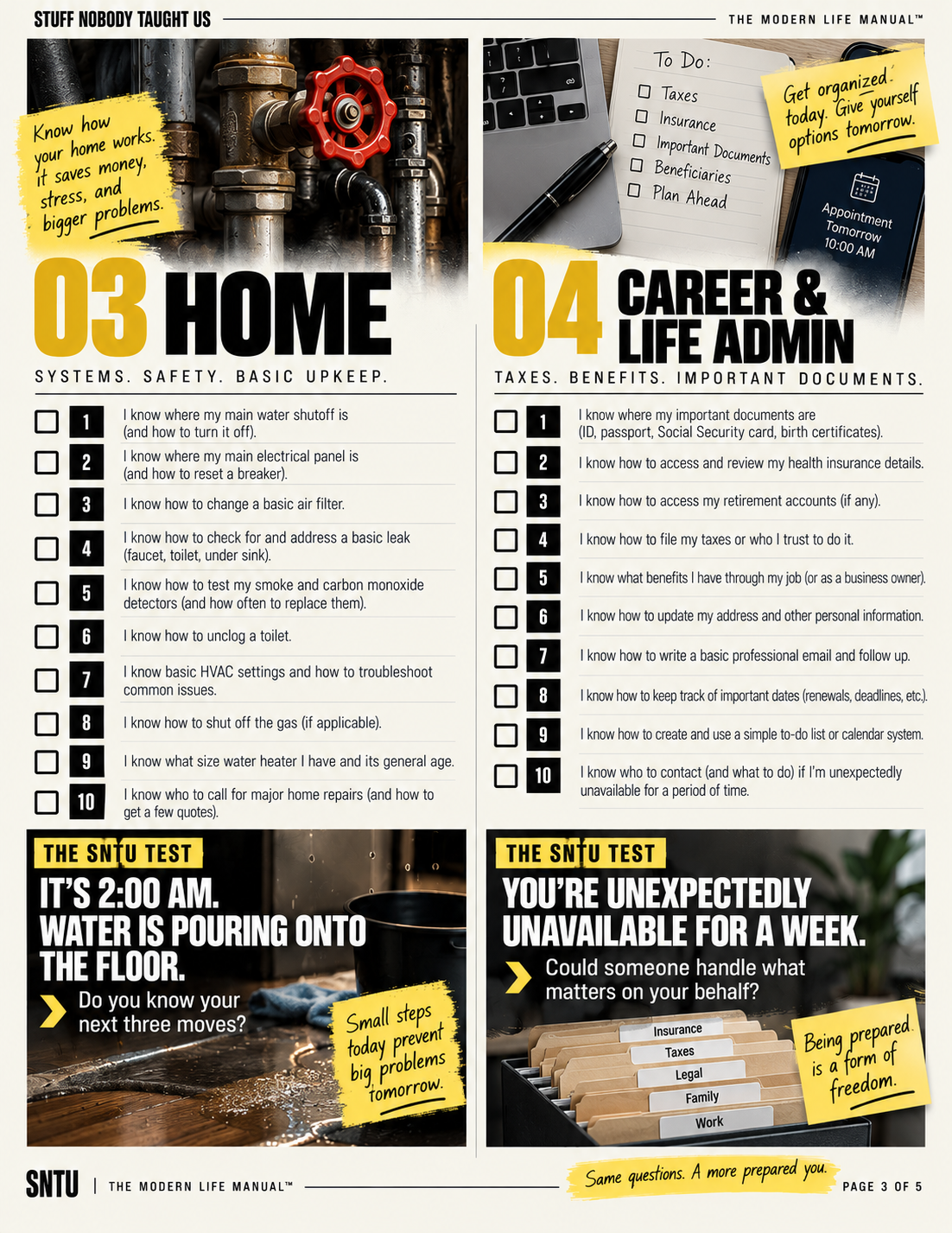
Download The “I Should Probably Know This” Checklist. 50 things every adult should know how to find, check, understand, or do across Money, Cars, Home, Life Admin, and Preparedness.
RELATED FIELD MANUALS
If a pipe bursts tonight, do you know how to stop the water?
Water damage causes thousands in damage within minutes. If you have to search for the shutoff valve while water is shooting through your ceiling, you're already too late.

This HVAC filter has an arrow. It actually matters.
Putting an air filter in backward chokes your blower motor, bends the frame, and lets dust bypass directly into your evaporator coils.

The 72-Hour Water Rule: How much you actually need.
When municipal water is contaminated or the power grid goes down, grocery store shelves empty within 2 hours. One gallon per person per day is the biological baseline.